
You open the doors, check the deliveries, cover the pass, close the till and answer messages at midnight. The restaurant runs, but only because you never stop. The cause is rarely too much work. It is that nobody else owns any of it.
Why owners don't delegate
"Nobody does it like me." "It's quicker if I do it." "I can't trust anyone with that." Every overloaded owner has said at least one of these.
Each one is partly true in the short term. Doing it yourself is faster today. But it is slower every day after that, because the task never leaves your desk. Firefighting works up to a point, and then it becomes the ceiling of the business.
The org chart: who owns what
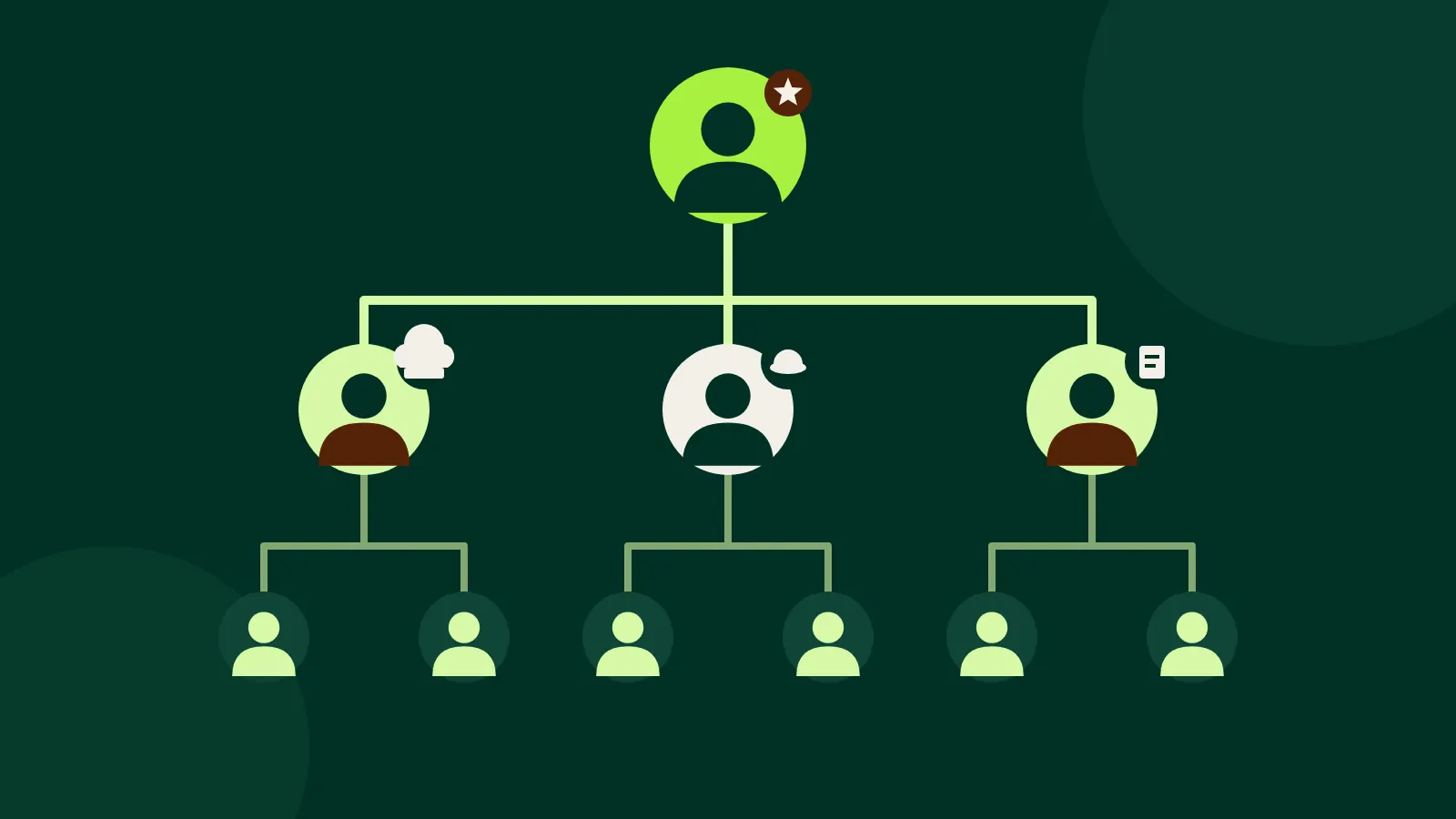
An org chart sounds corporate, but in a restaurant it can fit on one sheet of paper. It answers two questions for each area: who is responsible, and who do they report to.
A typical small restaurant might look like this:
- Owner: direction, money, big decisions, the brand.
- Front-of-house manager: the floor, the service team, rotas, guest experience.
- Head chef or kitchen lead: the kitchen, quality, prep, food costs.
- Purchasing and stock: one named person, if the size justifies it.
In a very small team, one person may wear two hats. That is fine. What matters is that every area has a name next to it, so nothing falls between chairs and nobody has to guess.
Delegating is not abandoning
Handing someone a problem and disappearing is not delegating. Done well, it has four steps:
- Define it. What exactly is the responsibility, and what does "done well" look like?
- Train for it. Show how it is done, ideally once, in a way that can be reused.
- Give room to decide. Within that area, let the person make calls without asking you each time.
- Check in, don't hover. Agree a regular moment to review, instead of watching every move.
Delegating this way does not make you lose control. It gives you more, because you stop drowning in detail and start seeing the business from above.
A worked example
Say you spend about an hour a day on supplier orders and stock counts. That is roughly seven hours a week, close to a full working day.
You write down how you do it: which suppliers, which days, the usual quantities and the warning signs. You walk your kitchen lead through it for two weeks. After that, they place the orders and you review a short summary every Monday.
You have not lost control of purchasing. You have swapped seven hours of doing for twenty minutes of reviewing. The numbers are hypothetical, but the shape of the trade is the point.
Meet less, with more focus
Once areas have owners, you no longer need to solve a hundred small things a day. A weekly meeting with your manager and your chef, with a short agenda and a few numbers, can replace most of the interruptions.
Focus on the few things that move the business the most, and let the people closest to the work handle the rest.
The fatal mistake
Believing that delegating is weakness. An owner who does everything is not strong, they are stuck. An owner who delegates well is free to think, to plan, and to build a business that can grow beyond one pair of hands.
Where your tools help
Delegating is easier when the team works from the same system. When orders, payments and customer details live in one dashboard, your manager does not need to ask you where things are, and you can see what is happening without being on the floor.
GetFoodies gives your team that common ground: online orders on your own branded site, a kitchen display, and a dashboard with orders, customers and numbers.
Start with one task
Pick one thing you do today that someone else could do. Define it, train for it, hand it over and agree when you will check in. That first handover shows you the restaurant does not fall apart without you, and it opens the way to the next one.
If you want a calmer base to delegate from, you can create your free site and see how it fits your team.